
Why Winning Teams Focus on a Few Key Metrics
The scoreboard your team is missing and how to build one.


From the Stanley Cup to the NBA playoffs to the World Cup, we’ve had weeks of high-intensity sports. Professional sports teams run on mountains of data: player statistics, advanced analytics, predictive models. But during the game, they rely on just a handful of numbers on the scoreboard. Those tell them where they stand, how much time remains, and what they need to win.
If I had to pick one data practice that can fundamentally change how a team operates, it would be building these for your work.
Most managers think they already have a scoreboard. They point to annual goals, weekly dashboards, or whatever performance framework is currently in favor. But those numbers rarely guide how the team directs its time and energy each day.
Imagine a basketball team playing without knowing the score or how much time was left. Or imagine their scoreboard showing 45 different statistics. Lots of numbers, very little focus. Now compare that to how an elite team plays when the board shows a close score and a clock counting down.
Are you creating the same intensity and focus for your team? Probably not. That’s not a criticism - there are not a lot of practical roadmaps for this.
Why teams struggle
Building an effective scoreboard is simple, but not always easy.
Teams rarely suffer from a lack of metrics. The shortage is clarity. People don’t understand how measures are defined or calculated. They can’t see how their day-to-day work connects to the numbers they are being asked to move. Sometimes the data isn’t reliable enough to trust. Sometimes the metrics just aren’t part of the team’s rhythm. The numbers aren’t discussed regularly, used in decision-making, or reviewed often enough to shape behavior.
Underneath these issues sits a common root cause: the team never identified and operationalized the few numbers that actually tell them whether they’re winning. And in some cases, they haven’t clearly defined what winning looks like.
What happens when you get this right
A good scoreboard clears out workplace noise and removes the low-level anxiety that comes from never quite knowing if you’re succeeding. Why? Because you can see where you stand and what you need to win the game.
When done well, it creates momentum, protects against burnout, and helps people make good decisions when you are not in the room.
Fewer, more targeted metrics also create more freedom. This means that you might have a different scoreboard for different individuals or groups on the team. When people understand the score, they can experiment and make decisions on their own because the score itself becomes the feedback loop. What did we try? Did it work? What do we do next? How much time do we have left?
Your scoreboard will evolve. You probably won’t get it right on the first attempt. The targets may shift as you build momentum. At some point, you may make enough progress that you turn the focus onto a different set of metrics designed to tackle a different set of challenges. This is a sign that the scoreboard is working.
The most important thing is to start. Most of us are being asked to do more with less: businesses navigating restructuring and layoffs, nonprofits facing funding cuts, and individuals juggling increasing demands on their time and energy.
How to build your scoreboard
Having a scoreboard is not about doing more. This is about focus, and about being just as intentional about what you leave off the scoreboard as what you include.
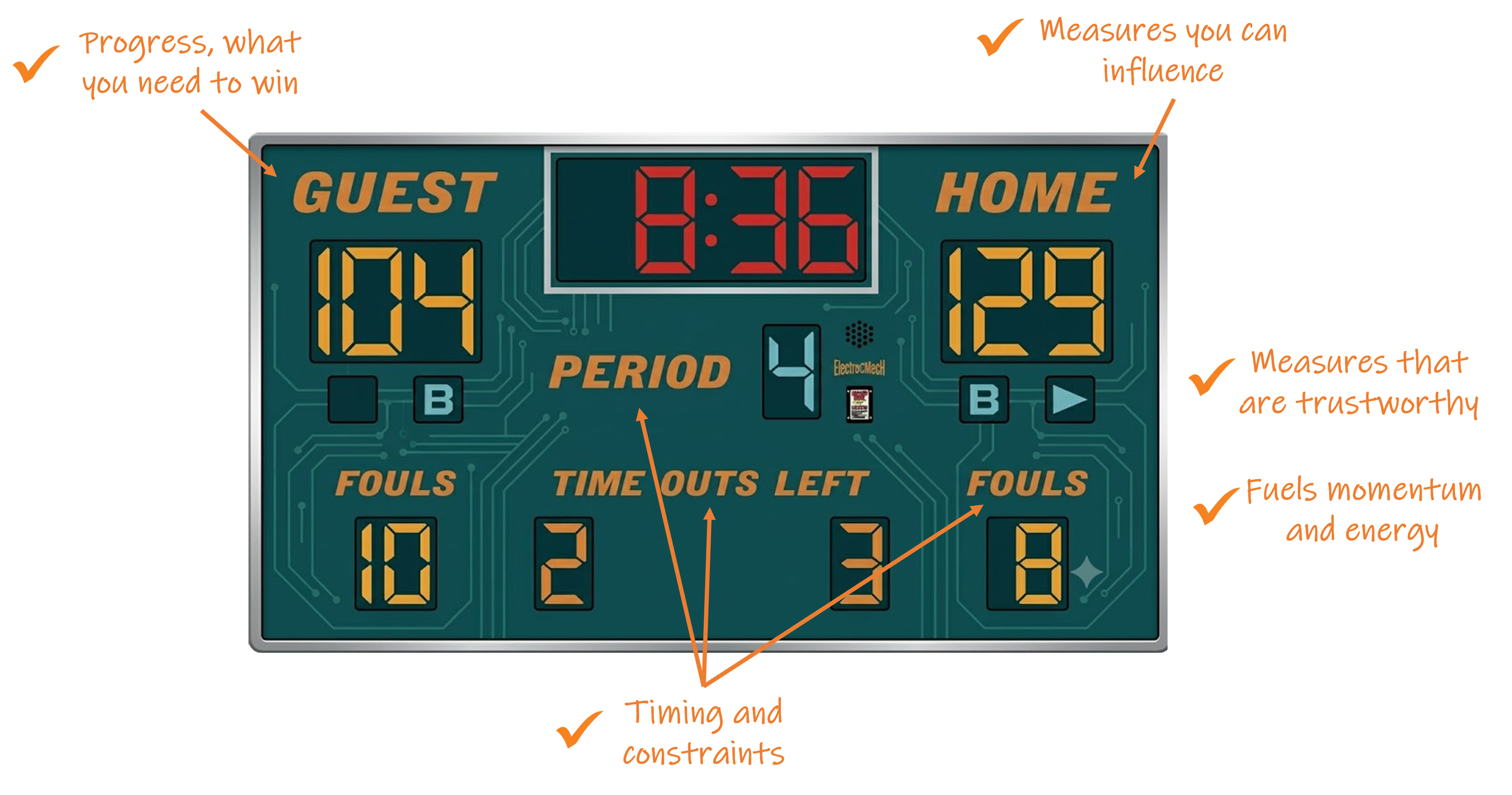
When building a scoreboard, I design for these 5 elements:
Measures that you can influence. People need to be able to see the connection between what they do each day and the numbers they’re being asked to move. If they nail those numbers, the larger goal takes care of itself. In our sports analogy, these are the points on the board.
Progress that is quickly visible. When someone can quickly assess where they stand right now versus where they need to go, it changes what they prioritize. They put their energy into figuring out how to move that number.
Timing and constraints. Time remaining, available budget, available hours left for the project. These are the equivalent of the shot clock, available timeouts, or number of fouls. These limits influence what winning realistically looks like right now.
Measures that are trustworthy. If a metric can’t be easily and reliably measured, it doesn’t belong on the scoreboard.
The final test: it fuels energy and momentum. You’ll know you’re there when people are proactively looking at the numbers, the right behaviors are following, and you’re starting to see momentum. It won’t be linear, but the progress will be visible.
What it looks like in practice
Here’s what this could look like in practice.
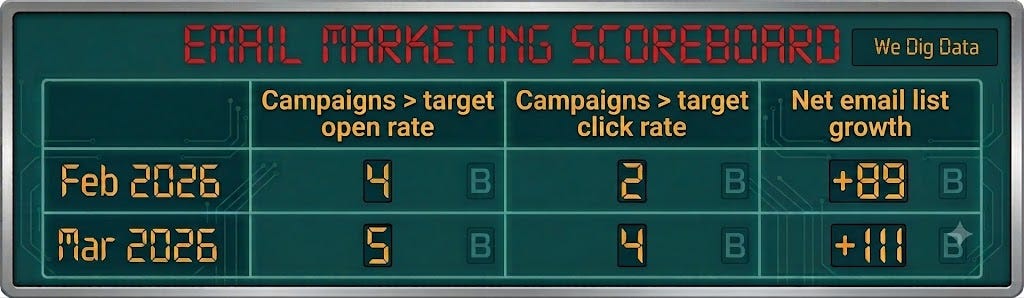
An email marketer wants to grow website traffic. She could track the percentage of people who open their emails and click-through to the website for each campaign. And she will, but that’s not her scoreboard. Her scoreboard asks a more motivating question: how often are we beating our targets, and is that happening more often than before.
Instead of “What was our open rate this month?”, she asks:
“How many campaigns exceeded our targets? Did we do that more times this month than last, and why?”
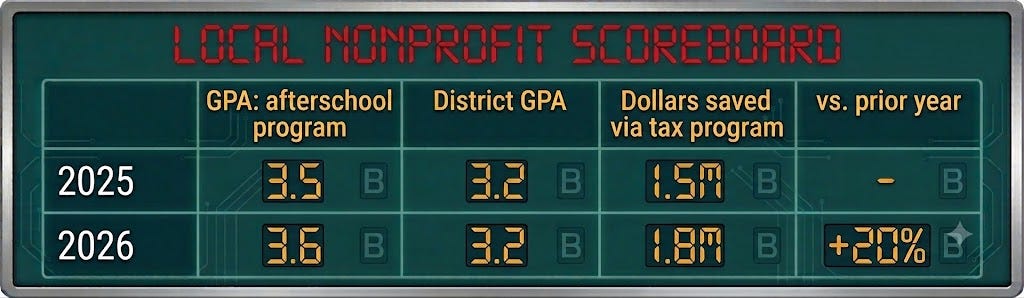
A local nonprofit works to house lower-income families and help them flourish. They track how many clients they serve, of course, but that’s not their scoreboard. Their scoreboard tracks two numbers that guide their daily operating decisions: the GPAs of kids in their free afterschool program compared to the district average, and dollars saved through their annual tax help program. That second one matters because every dollar saved in taxes goes directly into a family’s bank account.
Instead of “How many families did we serve this year?” they ask:
“Are the kids in our program outperforming their peers, and are we putting more money back in families’ pockets than we did before?”
Scoreboards can look different by person or team. What matters is identifying the handful of numbers that answer two questions: Where are we? And what do we need to win?
A good scoreboard won’t eliminate uncertainty, but it will give people a clearer way to direct their limited time and attention.