


As data has become central to how organizations operate and make decisions, the number of roles and titles for “data people” has grown and the boundaries between them have blurred. Analyst. Engineer. Scientist. Steward.
These titles are meant to hint at different kinds of work, but in practice they overlap far more - and shift more often - than most job descriptions suggest.
Titles are a weak proxy for how someone can help you
Data roles evolve. Tools change, teams grow, and work shifts from exploratory to operational. Titles often stay the same because changing them feels like overhead - even when the day-to-day work looks very different from what the title implies.
In other cases, the mismatch starts from the outset. A title is chosen based on reasonable, but incomplete, assumptions about what a “data analyst,” “data scientist,” or “data engineer” does, often borrowed from another organization or a job description. The title signals intent or aspiration, not a precise account of the work.
In larger organizations, the issue is often structural. A small set of standardized data titles spans many teams and responsibilities. These titles work for HR systems and career paths, but they flatten important differences in how people actually spend their time.
The takeaway? It’s simple: titles are a weak proxy for how someone can help you. Whether you’re coordinating data work or contributing to it, assuming fit based on a title alone will create friction with your data partner. Understanding what people actually do - where they add value and how they work with ambiguity - matters far more than what their role is called.
Common Situation #1: One title, many jobs
Data analysts are everywhere. Most teams have at least one, regardless of size or industry. In my own experience on both small teams and in larger organizations, the role consistently shows up, but what it involves can vary widely.
While the title suggests analytic work (examination, interpretation, decision support), in practice these roles are often heavily operational. Maintaining pipelines and reports, and keeping data reliable and consistent, make up much of the day-to-day work. Analysis still happens, but it’s typically incremental and bounded by existing data structures and processes.
Common Situation #2: Same title, different work
I once managed a small team that included two people with the title “data scientist.” One had a robust academic background in advanced math and machine learning theory, and excelled at model selection - but only once the work was clearly defined. His grasp of the business context was limited, and his approach tended to be more literal than creative when deciding how to apply data science techniques.
The other data scientist did not come from a rigorous academic training environment and was less familiar with more complex models. This person was exceptionally strong at shaping the work itself - developing creative approaches, having an instinctive feel for what the data could and couldn’t support, and anticipating the end-to-end impact on the resulting product.
The title alone would never have told you who was best suited to define the work and who was strongest at executing it. That clarity is what allowed the team and its partners to move faster and work more effectively.
Finding the right data partner in practice
Finding the right data partner isn’t a one-time decision. It depends on where the work is and what it needs next.
If the work is still fuzzy, you may need someone who can help shape it, even if they aren’t the most technically specialized person on the team. If the work is well defined, execution strength matters more. And if the work needs to run over time, operational skills are critical, regardless of title.
Titles can help you find people. They can’t tell you how the work will unfold. Expect variation within roles, expect to involve more than one partner, and expect your needs to change as the work evolves.
Translation Guide: from need to data language to titles
Once you can translate your need into language data teams recognize, titles become useful not as answers, but as navigation aids.
This isn’t about getting the terminology exactly right. It’s about giving your data partners something concrete to react to.
The same title may appear in multiple rows - that’s expected. What matters is the work being asked for, not the label.
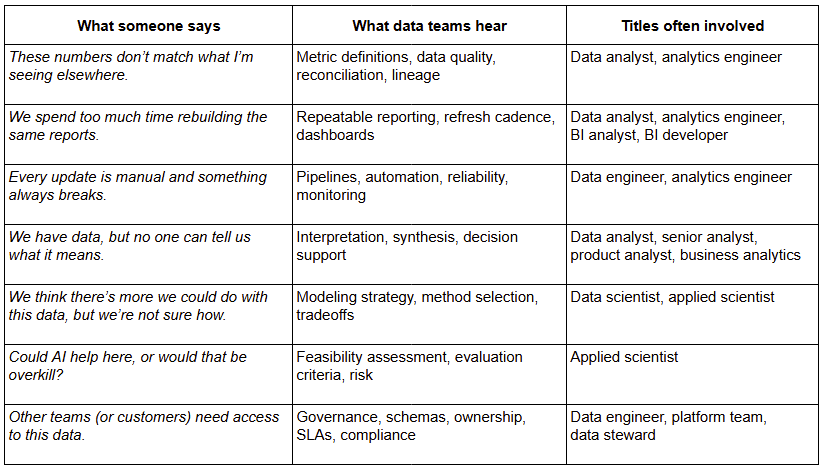
Note that some organizations use the title applied scientist to distinguish method-heavy, machine learning focused work from broader data science. Others don’t. The work shows up either way.
When you let the work guide you, titles stop being a source of friction and start becoming useful signals.